
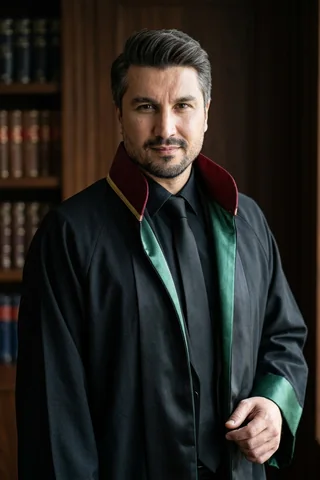
Istanbul Bar attorney
Av. Serkan Kara
Attorney at law. Bachelor of Law (LLB), Uludağ University Faculty of Law, 2015; trained and admitted in Turkish and continental civil law, United States law read at the University of Cologne.
In the legal profession since 2015, on matters where at least two legal systems have to agree at once. The legal position of foreigners, investment migration and citizenship is his oldest specialism; technology companies are the second. He handles every file himself and answers for each one personally.
- Vice President, TÜSODER
- Russian MFA attorney directory, Oct 2025
- Cornell LII lawyer directory
- Uludağ University, Faculty of Law, LLB 2015
- University of Cologne, CUSL 2012–2013
- 2015In the profession since
- CCBEEuropean lawyer's identity card
Articles
- Artificial Intelligence and Legal Technology in the Legal Profession: The Statutory Reserve, Professional Secrecy and the Duty to Verify
- Retrograde Extrapolation of Blood Alcohol Concentration in Turkish Law: The Fixed Hourly Rate and the Evidential Limits of the Widmark Equation
- The Evidential Value of Hash Values in Turkish Criminal Procedure: Integrity, Time and Origin of Seized Digital Data
- The Lawyer's Release: AI Agents, Automation Bias and the Non-Delegable Duties of Turkish Law
Biography
Serkan Kara read law at Uludağ University and has been in the legal profession since 2015. The traineeship ran before the courts from 17 March 2015 to 17 September 2015 and then with an advocate from 18 September 2015 to 18 March 2016, a full year of it. The board of the Istanbul Bar Association entered him on the roll on 28 April 2016, the Avukatlık Ruhsatnamesi is dated 2 June 2016, and the Union of Turkish Bar Associations carries him on its register. The entry itself is public on the Istanbul Bar roll.
Serkan Kara commands both of the great legal families, and that is a matter of record rather than of self-description. Turkish and continental civil law is the tradition he was trained and admitted in, with a Bachelor of Law (LLB) from Uludağ University Faculty of Law in 2015. Anglo-American common law he read at the Faculty of Law of the University of Cologne, on Erasmus in 2012 and 2013, on the CUSL programme in United States law: US family law, business law, legal negotiations and American legal terminology, two of them graded vollbefriedigend, a grade that, on the scale the transcript itself describes, 10 to 12 per cent of candidates reach. The transcript is sealed and apostilled.
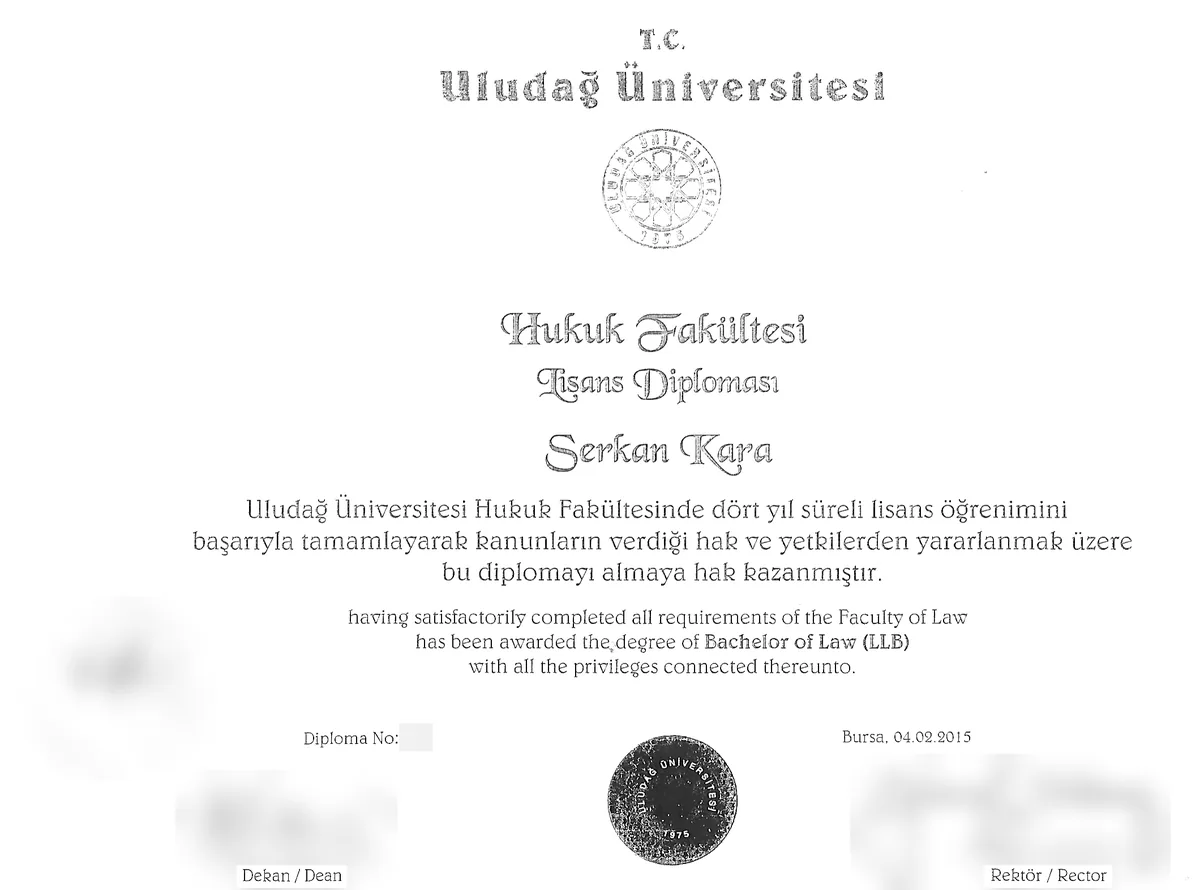 Law diploma, Uludağ University, 2015
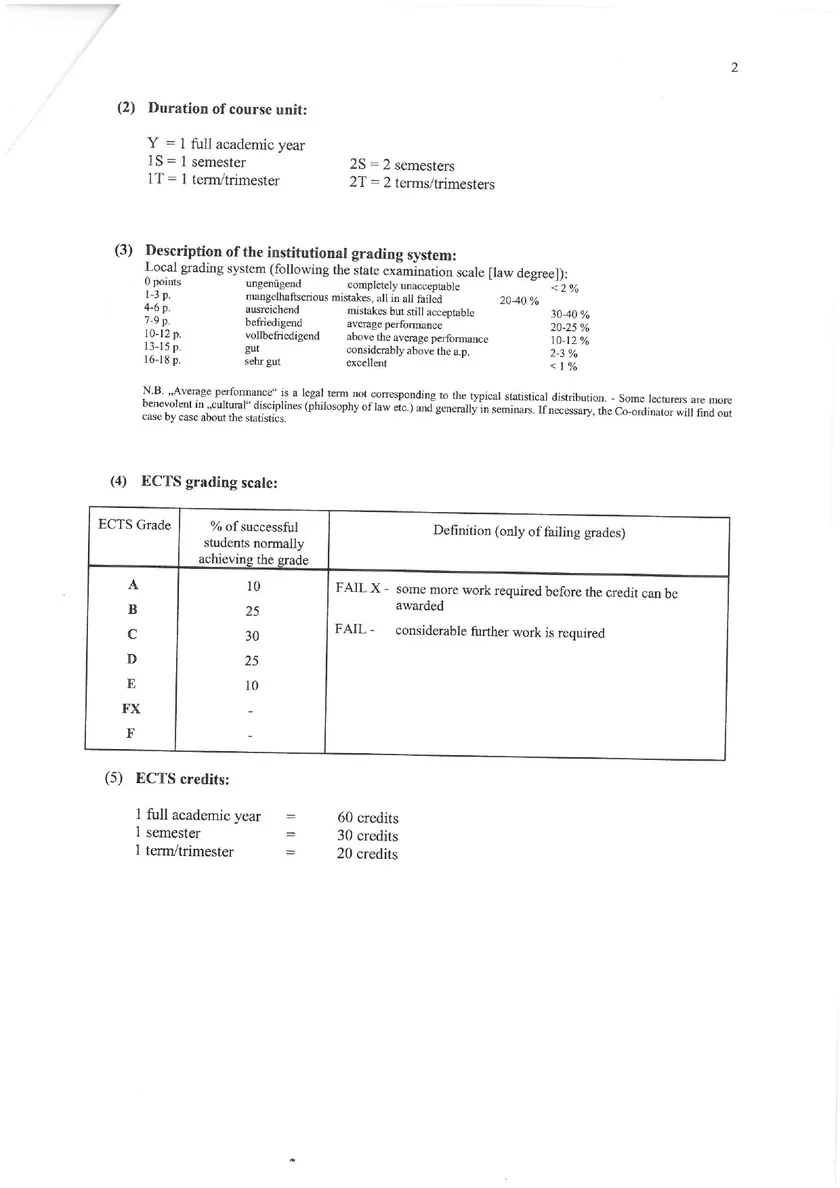 Transcript, page 2: the grading table
Comparative training is not decoration in this work. The same contractual clause carries different consequences under continental civil law and under Anglo-American common law, and a foreign client's exposure usually sits precisely in that gap. Reading both systems is what makes a file opened in one country predictable to a board sitting in another, and it is why cross-border work is ordinary for him rather than exceptional.
The CCBE Lawyer's Professional Identity Card is the instrument by which the European legal profession identifies a lawyer outside his own jurisdiction, and Serkan Kara holds one. It was created in 1978, it is issued by the national bar in the CCBE's name after that bar has verified that the applicant is a lawyer currently authorised and registered with it, and it is recognised by the European Court of Justice and the Court of First Instance. It identifies its holder, in the CCBE's official languages, as a lawyer admitted in his own country and eases his access to courts and institutions outside it, as the CCBE states on its own page.
He enters a file in the same order every time: the document itself, then the statute or the scientific source it rests on, then every date, figure and register entry measured against its source; the written word comes last. Beside the law he reads medicine, pharmacology, forensic toxicology and social psychology in their primary literature. Where a file rests on a medical report, a medicine's authorised product information or a laboratory result, the published text of that science stands in the pleading beside the statute, so the knowledge a judge will weigh reaches the judge with its source. Official letters and expert reports he reads against the file and the sources they rest on. His articles are written with the same discipline.
The legal position of foreigners in Türkiye has been at the centre of his work since his first years in the profession, and the trust placed in him there is on record with the official missions of four states. The Consulates-General in Istanbul of Kyrgyzstan (20 June 2016), Kazakhstan (11 July 2016), Uzbekistan (9 March 2017) and Ukraine (11 March 2019) appointed Serkan Kara, by general powers of attorney under their seals, to act before the Turkish courts, enforcement offices, ministries and migration authorities. The Kazakh, Uzbek and Kyrgyz instruments add the power to obtain, from public and private institutions, the information and documents concerning the consulate and its nationals. He conducted the consular representations under these genuine powers of attorney, received officially and in person from the consulates general, and he still carries them on from time to time.
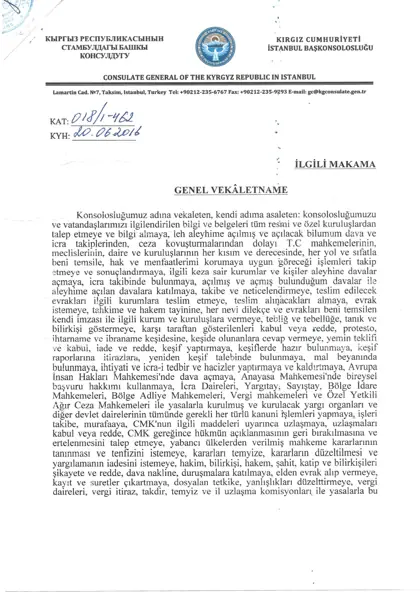 Kyrgyzstan, 20.06.2016
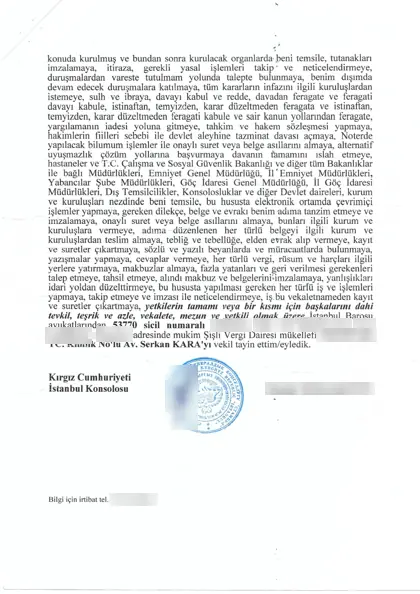 Kyrgyzstan, sealed page
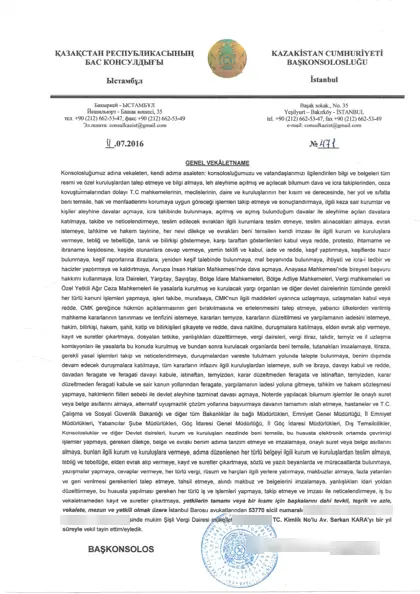 Kazakhstan, 11.07.2016, No 471
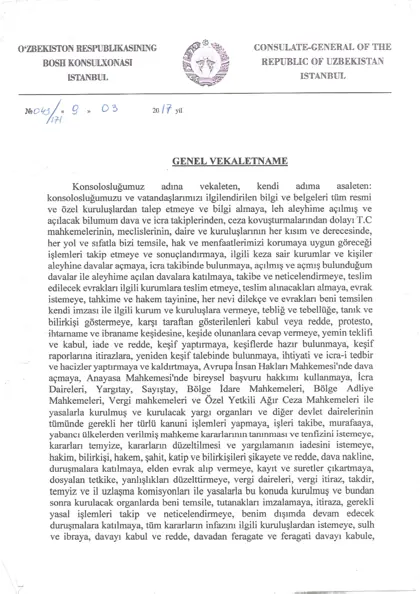 Uzbekistan, 09.03.2017
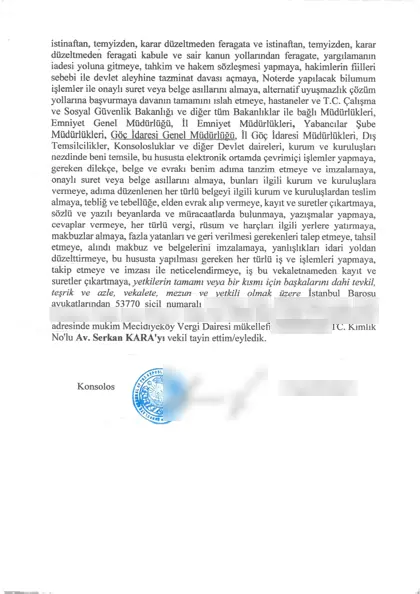 Uzbekistan, sealed page
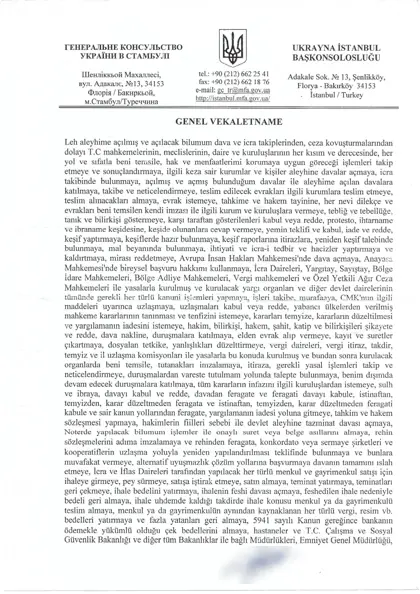 Ukraine, 11.03.2019
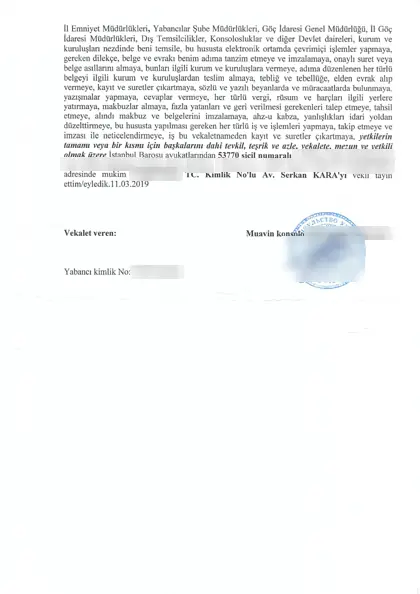 Ukraine, sealed page
The images are the sealed pages of the instruments, which are drawn up in Turkish. The issuing consulate-general, the date and number of each instrument and Serkan Kara's name remain legible; identity numbers, addresses, a telephone number, the names of the signing consuls and every signature, those drawn across a seal included, are blurred in the image itself.
The field side of that trust was the Kumkapı Removal Centre in Istanbul. Serkan Kara worked there alongside the consuls of Kazakhstan and Kyrgyzstan, together with the deputy governor serving as Istanbul's Provincial Director of Migration Management. That work laid the ground for an amendment to Law No. 6458 on Foreigners and International Protection, the statute that governs how foreigners enter Türkiye, stay there and are removed from it.
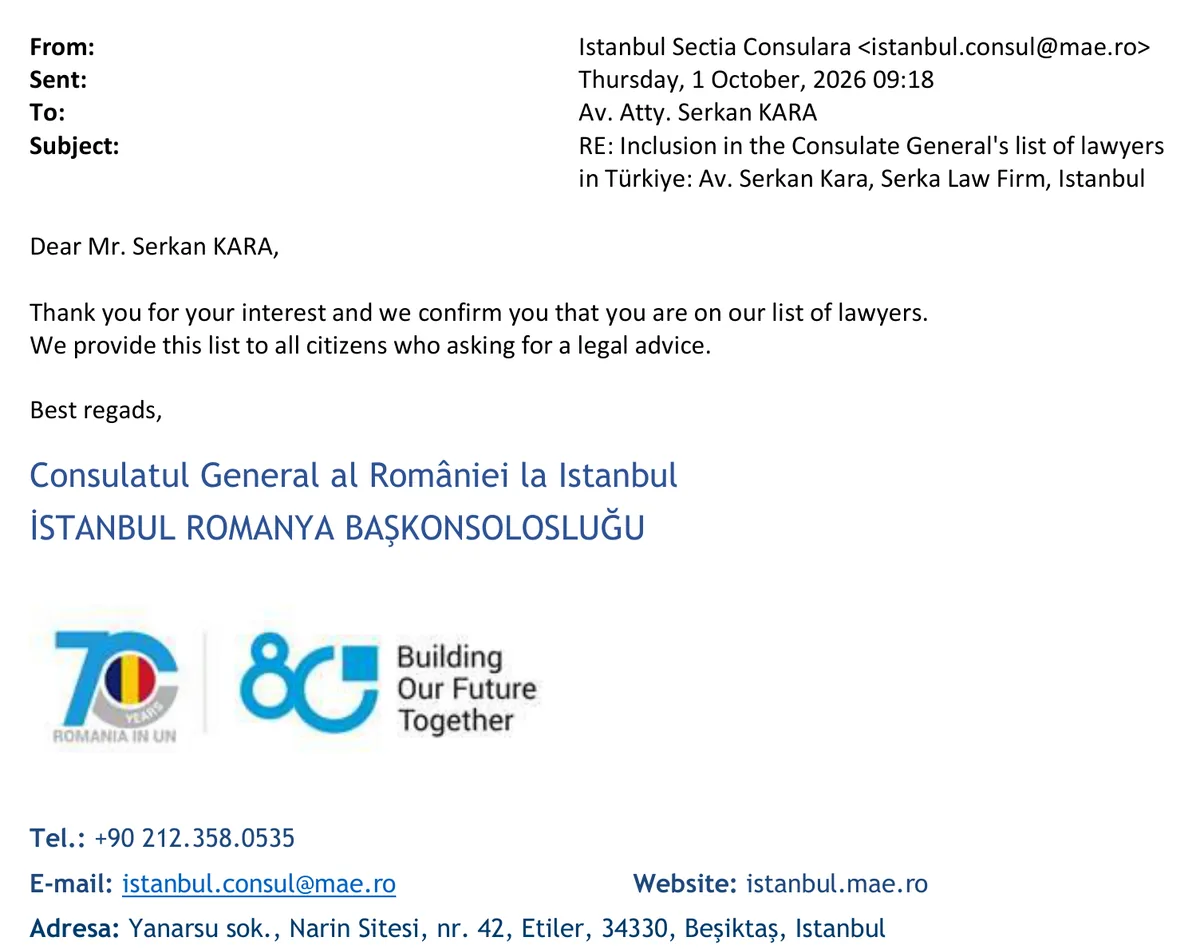
Romania's consulate in the city keeps a record of another kind. In its reply of 1 October 2026, the consular section of the Consulate General of Romania in Istanbul wrote to Serkan Kara that he is “on our list of lawyers” and that the consulate provides this list to its citizens who ask for legal advice.
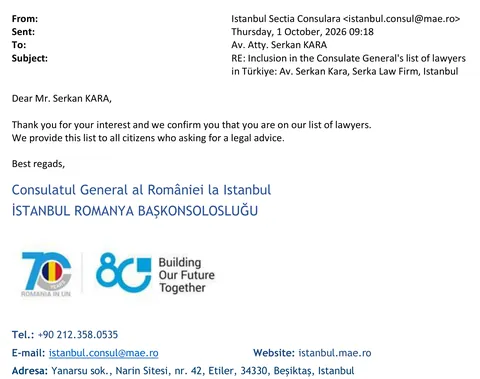 Romania, 01.10.2026
The Russian Foreign Ministry's list of lawyers in Turkey, published in October 2025, carries the office he founded under the name Serka Hukuk Bürosu, with Serkan Kara named inside the entry. The Russian Embassy in Ankara and the Consulates General in Antalya, Istanbul and Trabzon compiled it from information the listed lawyers supplied themselves, so it records presence and not endorsement, and it is cited here on that footing. Cornell Law School's Legal Information Institute carries him in its own lawyer directory. He holds a ten-year United States B1/B2 visa.
Serkan Kara has worked hands-on with software and hardware since the age of eleven, in the MS-DOS era, and never left it, so the technical half of this biography begins earlier than the legal half. Today he works on machine learning at code level. He is a member of the Google Developer Program at its Premium tier, and that profile is public: g.dev/serka. He is a member of the Apple Developer Program and the architect of the Serka app. It is a second competence that stands beside the advocacy.
A technology matter usually turns on a technical fact before it turns on a legal one: how a model pipeline was assembled, where its training data came from, which processor holds what and under whose law, what a platform's own terms already bind the client to. Those facts are established here by reading the system itself, so the technical answer and the legal one arrive in the same document. His articles on law and legal technology, each claim beside the primary source that bears it, are published on this site under Articles.
English has been at native level since the age of seven, which is why an English contract is read rather than translated. German came from years spent in Germany. Turkish is the language of every filing that goes before a Turkish court; correspondence with a client runs in the client's own language.
Alongside private practice Serkan Kara serves as Vice President of TÜSODER, the Turkish consumer-rights association, and his commentary on consumer and commercial law has been broadcast by CNN Türk, A Haber, Flash TV, Beykent TV and the DHA news agency. The firm he founded is Serka Hukuk Bürosu in Turkish and Serka Law Firm internationally.
What can be checked, and where
The Istanbul Bar link opens on the roll entry itself. Every other record is written with the name of the body that keeps it, its number and its date.
- Istanbul BarTraineeship before the courts from 17 March 2015 to 17 September 2015, then with an advocate from 18 September 2015 to 18 March 2016, a full year of it. Entered on the roll by board decision of 28 April 2016. The Istanbul Bar roll entry opens on the record itself.
- Union of Turkish Bar AssociationsThe Avukatlık Ruhsatnamesi, the Turkish certificate of advocacy, is dated 2 June 2016.
- CCBEHolder of the CCBE Lawyer's Professional Identity Card. A national bar issues it, so the roll entry above is the record standing behind it. What the CCBE card is, from the CCBE.
- Uludağ UniversityFaculty of Law, Bachelor of Law (LLB), 2015. The Turkish and continental civil law half of the training, and the degree on which the bar admission rests.
- University of CologneUnited States law programme (CUSL) at the Faculty of Law, on Erasmus, 2012–2013, two subjects graded vollbefriedigend. The transcript is sealed and apostilled. The CUSL programme at the Faculty of Law.
- Consulates-General in IstanbulGeneral powers of attorney under seal: Kyrgyzstan 20.06.2016, KAT 018/1-462; Kazakhstan 11.07.2016, No 471; Uzbekistan 09.03.2017, No 043/171; Ukraine 11.03.2019. Small images of the seven pages stand in the biography.
- Consulate General of Romania, IstanbulOn the list of lawyers the consulate gives its citizens who ask for legal advice; written reply of its consular section, 01.10.2026. The reply is shown in the biography.
- Google Developer ProgramMember at the Premium tier of Google's own developer programme; the profile is public at g.dev/serka. What the tiers are, from Google.
- Russian Ministry of Foreign AffairsThe office he founded is listed in the ministry's list of lawyers in Turkey, October 2025, as Serka Hukuk Bürosu, with Av. Serkan Kara named inside the entry. The list is informational and is not a recommendation.
- Cornell Law SchoolListed in the lawyer directory of the Legal Information Institute.
- TÜSODERVice President of the Turkish consumer-rights association. The association's board page, archived 14.07.2026.
- Legal commentaryCNN Türk, A Haber, Flash TV, Beykent TV and the DHA news agency, on consumer and commercial law.
What gets asked, and the answer
What is asked about him before a power of attorney is given.
There are other lawyers with this name. Which one are you?
The one carried on the Istanbul Bar roll, entered there by decision of the Bar's board on 28 April 2016, holding the Avukatlık Ruhsatnamesi of 2 June 2016, and registered with the Union of Turkish Bar Associations. The Bar's own certificate of 28 August 2026 records that no disciplinary proceedings stand against him, and its certificate of 29 September 2026 counts 10 years, 3 months and 27 days of practice since the licence was granted. Both open on the Bar's document verification page with their codes, 941bb260 and 643ac616. A name is not an identifier and a roll number is, so open the Istanbul Bar roll entry and read that before you read anything else on this page. The rest of the record, and the register behind each piece of it, is set out in what can be checked, and where.
Who actually does the work on my file?
The power of attorney is drawn up in the name of Av. Serkan Kara, entered on the Istanbul Bar roll; the filings carry his signature and he is the advocate answerable for the file. If you want to establish whom the mandate goes to before you send anything at all, the Istanbul Bar register settles it on its own.
Will you act against a Turkish party for a foreign client?
Yes. The duty runs to the client, and no ground on which an advocate must refuse a matter turns on the nationality of the other side. What does decide it is conflict, and that check runs before the scope is written rather than after: it asks whether Serkan Kara has already acted for, or given an opinion to, a party whose interest is opposed to yours in the same matter. Avukatlık Kanunu No. 1136, art. 38 lists the situations in which an advocate is obliged to refuse, and that is one of them. If the check comes back against you, you are told at the first message and not after you have paid.
Is what I send you protected before I have engaged you?
Article 36 of Avukatlık Kanunu No. 1136 prohibits advocates from disclosing matters entrusted to them or learnt by reason of the advocacy, and extends the same prohibition to what is learnt through duties in the organs of the Union of Turkish Bar Associations and the bars. Under the same article an advocate may give evidence about those matters only with the consent of the person whose matter it is, may decline to give it even with that consent, and, by a sentence added in 2001, incurs no civil or criminal liability for declining. That is the statute, and it is linked so you can read it rather than take it on trust. Serkan Kara's own practice does not wait for an engagement: what arrives at first contact is treated as confidential from the moment it arrives, whether or not an engagement follows, and it is discussed with nobody. Article 39 of the same law answers what happens to the file afterwards, and it has two halves: documents entrusted to an advocate are kept for three years from the end of the retainer, and where the client has been notified in writing to collect them the obligation ends three months after the date of that notice. The second half is the one a summary usually drops. He keeps his own side of that simple: you are written to before a file is returned or closed, so you are never left guessing where your documents are.